Is 1,000 views good? Is 100,000 viral? You will find many confident answers online. Most of them are made-up numbers.
The honest answer is that "viral" depends on your account. This guide gives you three simple formulas instead of a magic number: views compared with your usual views, views compared with your followers, and likes compared with views. All the examples use round numbers so you can follow the maths.
Is there an official viral number on Instagram?
There is no official viral number on Instagram. Neither Instagram nor Meta publishes a view count that makes a Reel "viral". The useful question is whether a Reel did far better than your usual Reels. Compare its views with your average views and with your follower count to find out.
Here is the method in one passage you can save:
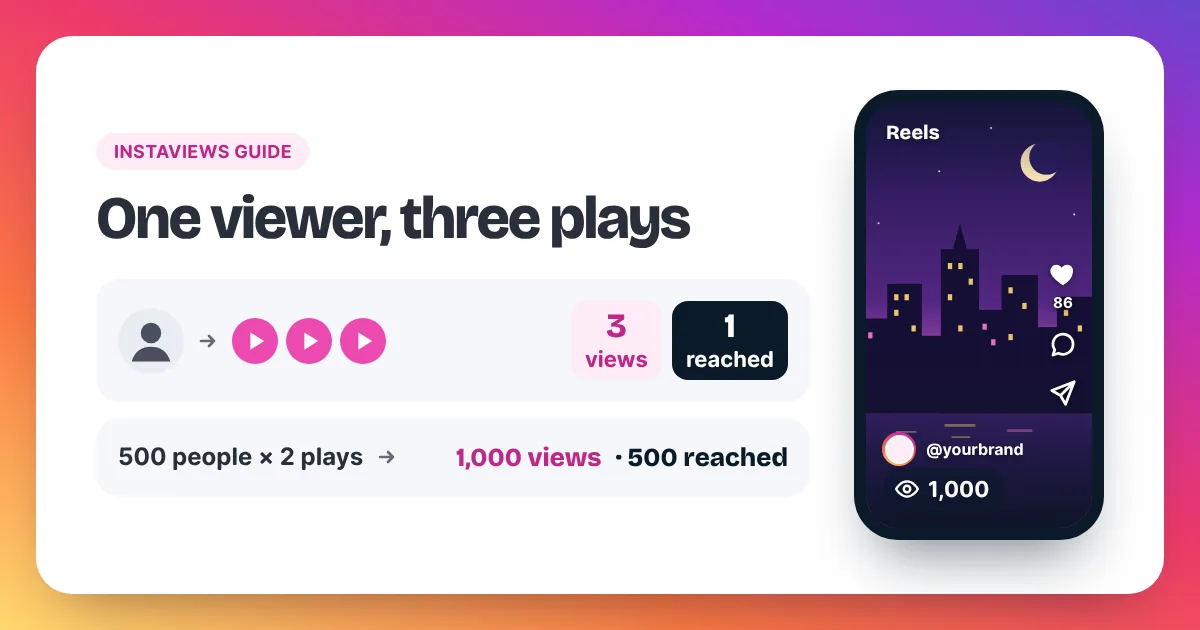
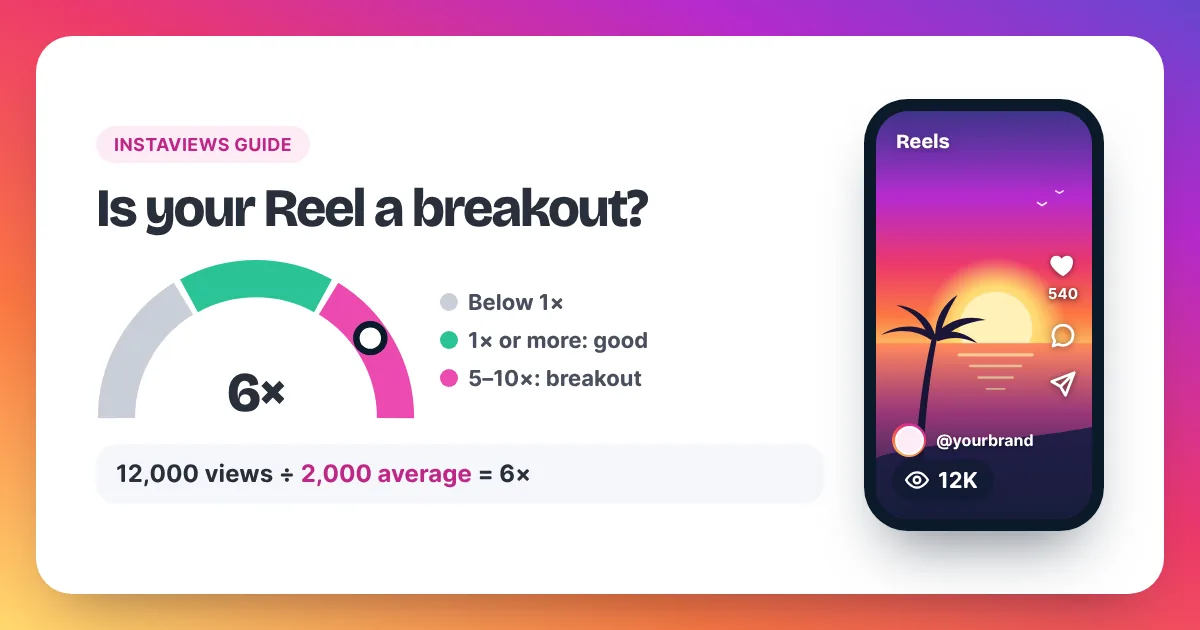
Instagram has no official definition of a viral Reel, so the best test is a ratio, not a fixed number. Start with your average: add up the views on your last 10 Reels and divide by 10. Then divide a new Reel's views by that average. A result above 1 means the Reel beat your usual. Our rule of thumb is that a Reel at 5 to 10 times your average is a breakout for your account. For example, if your last 10 Reels total 20,000 views, your average is 2,000, and a Reel with 12,000 views scores 6 times your average. A second ratio, views divided by followers, shows how far a Reel travelled beyond your own audience. Remember that Instagram counts a view each time a Reel starts to play, and again each time it replays, so views measure plays, not people.
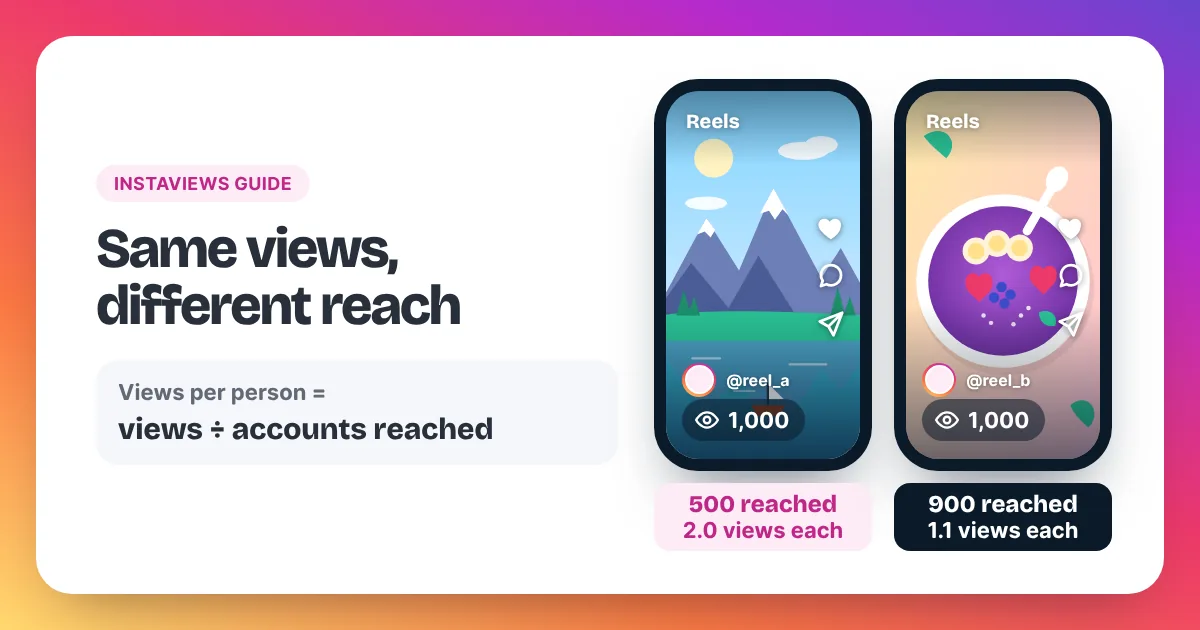
That last point matters. A Reel with 10,000 views did not always reach 10,000 people. Our guide on Instagram views vs reach shows how to check the people count.
How do you judge a Reel by comparing it with your average?
To judge a Reel on Instagram, compare it with your own average. Add the views on your last 10 Reels, divide by 10, then divide the new Reel's views by that average. Above 1 is a good result. Our rule of thumb calls 5 to 10 times your average a breakout.
Here is the worked example from our homepage section on viral maths:
- Add up the views on your last 10 Reels. For example, 2,100 + 1,800 + 2,600 + … = 20,000.
- Divide by 10. Here, 20,000 ÷ 10 = 2,000 views per Reel.
- Divide the new Reel's views by 2,000. A Reel with 12,000 views scores 12,000 ÷ 2,000 = 6.
Then place the result in a band. The bands below are our own yardstick, not an Instagram rule.
| Views ÷ your average | What it means | Example (average 2,000) |
|---|---|---|
| Below 1 | Below your usual | 1,500 views ÷ 2,000 = 0.75 |
| 1 or more | A good result for your account | 3,000 views ÷ 2,000 = 1.5 |
| 5 to 10 | A breakout for your account | 12,000 views ÷ 2,000 = 6 |
Why the last 10 Reels? Ten is enough to smooth out one lucky or unlucky post. It is also recent enough to reflect your current audience. If you post rarely, use whatever Reels you have from the last few months.
How do you judge a Reel by views ÷ followers?
To judge a Reel by followers, divide its views by your follower count. A result well above 1 means the Reel was played far more often than your audience size alone would explain. Views count replays, so check accounts reached in Insights to see how many different people it got to.
The formula:
Views per follower = Reel views ÷ followers
Here are some example accounts. They show the maths, not targets.
| Example | Followers | Reel views | Views ÷ followers |
|---|---|---|---|
| Small account, quiet Reel | 2,000 | 1,000 | 0.5 |
| Small account, strong Reel | 2,000 | 10,000 | 5 |
| Large account, quiet Reel | 50,000 | 10,000 | 0.2 |
Look at the second and third rows. Both Reels have 10,000 views. For the small account it is a huge result. For the large account it is a quiet one. That is why a single "viral number" makes no sense.
To turn likes, comments, shares and saves into one number, try our free Instagram engagement rate calculator. Use this ratio next to your average, not instead of it. Some accounts always get more views than followers. Others rarely do. Your own history is the fairest comparison.
What is a good views-to-likes ratio on Instagram?
A good views-to-likes ratio on Instagram is one that beats your own usual ratio. Instagram publishes no target. Divide likes by views and multiply by 100 to get a like rate. A Reel with 300 likes and 10,000 views has a 3% like rate. Track it across your Reels.
The formula:
Like rate = likes ÷ views × 100
A few examples, all made up for the maths:
| Example Reel | Views | Likes | Like rate |
|---|---|---|---|
| A | 1,000 | 50 | 5% |
| B | 10,000 | 300 | 3% |
| C | 45,000 | 900 | 2% |
Notice that Reel C has the most likes but the lowest like rate. Reels that travel far often reach people who do not know you yet, and those viewers may like less often. So a falling like rate on a big Reel is not always bad news. Read it next to the view count.
You can widen the same idea to engagement rate. Add likes, comments, shares and saves, divide by views and multiply by 100. For example, 400 interactions on 10,000 views is a 4% engagement rate. When this number rises across your Reels, your content is landing better with the people who see it.
Is 1,000 Reel views good?
Whether 1,000 Reel views is good depends on your account. For an account that usually gets 400 views, 1,000 is 2.5 times its average, a strong result. For an account that usually gets 20,000 views, 1,000 is a quiet Reel. Divide by your own average to know.
Two example accounts make this clear:
- A new account with 300 followers and an average of 400 views. A Reel with 1,000 views scores 1,000 ÷ 400 = 2.5 against its average, and 1,000 ÷ 300 ≈ 3.3 against its followers. That is a good week.
- An established account with 50,000 followers and an average of 20,000 views. The same 1,000 views scores 1,000 ÷ 20,000 = 0.05. Something went wrong, and it is worth checking why.
If your Reels sit below 1,000 views for a while, do not panic. Look at your hook, your posting time and how long people watch. The numbers you need are in Insights on a professional account.
Why do some Reels jump past your follower count?
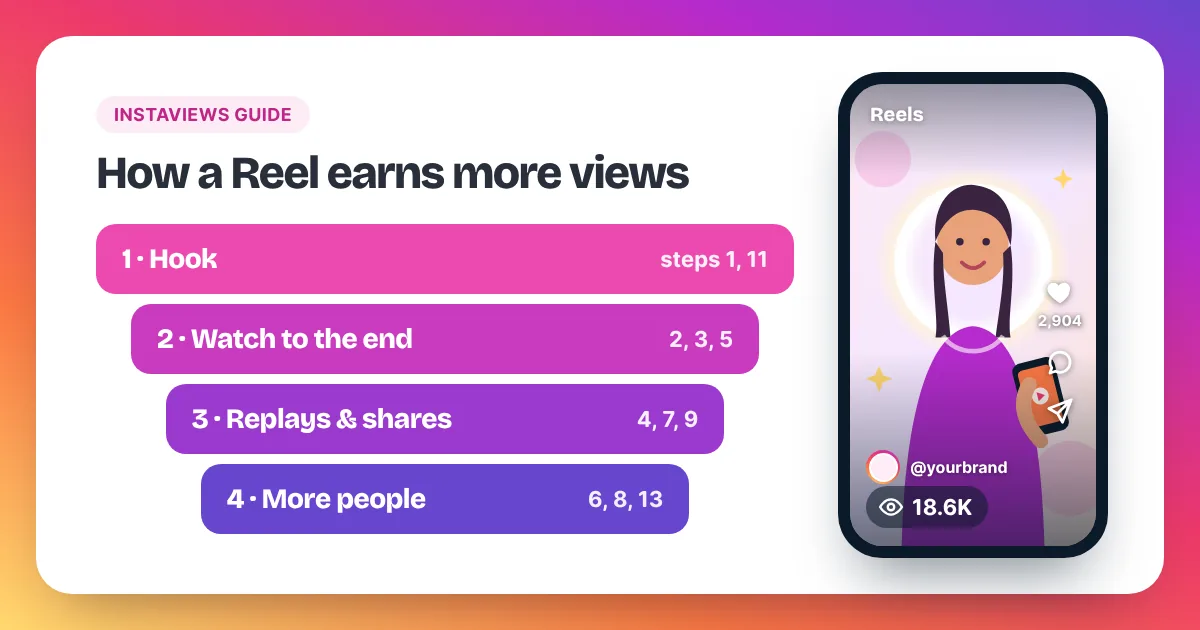
Some Reels jump past your follower count because views come from anyone who plays them, not only followers. Reels can show up in the Reels tab and Explore for people who don't follow you yet. Shares send a Reel to new people, and every replay adds another view.
Three things add up when a Reel takes off:
- New viewers. Explore is Instagram's discovery area, where people see posts and Reels from accounts they don't follow yet. A Reel that lands there can be played by far more people than follow you.
- Shares. Each share puts your Reel in front of someone new. Reels that are funny, useful or surprising give people a reason to share.
- Replays. Instagram counts a view each time a Reel starts to play, and again each time it replays. A short loop can earn several views from one viewer.
Because of replays, a Reel at 5 times your followers did not always reach 5 times as many people. Open Insights and divide views by accounts reached to see how much of the count came from rewatches.
For the full picture of what Instagram counts and why, read our pillar guide to views on Instagram.
How do you give a Reel a better start?
You give a Reel a better start on Instagram by nailing the first two seconds, adding captions, posting when your followers are online and replying to early comments. Some creators also add views right after posting so the Reel opens with a higher count. None of this turns a weak Reel viral.
The basics:
- Hook in the first 2 seconds. Open with a question, a bold claim or quick movement so people don't swipe away.
- Add on-screen captions. Many people watch Reels with the sound off.
- Make it loop. An ending that flows back into the start earns replays.
- Post when your followers are online. Check the most active times in Insights.
- Reply to early comments. Answer every comment in the first hour.
Our full guide on how to get more Instagram Reel views covers each step with examples.
If you want to add views to your best Reel, size the order to your account; our homepage guide on how many views to buy suggests 2 to 5 times your normal views per Reel. For the example account with a 2,000-view average, 5,000 views cost $8.95 and 10,000 views cost $15.90, our Most Popular pack. Our Reel views page explains how a Reel order works. Be honest about what bought views do. They raise the public count; they do not make people like, share or follow. Meta's Spam policy lists attempts to "artificially increase viewership", and Instagram can remove plays it treats as inauthentic. Keep any order in proportion to your account, and judge the Reel by likes, shares and reach as well as views.
Viral views on Instagram: frequently asked questions
How many Instagram Reel views is viral?
There is no official number. A Reel is a breakout for your account when it scores far above your own average. Our rule of thumb is 5 to 10 times your average views.
Is 10,000 views on Instagram viral?
It depends on your account. For an account averaging 1,000 views, 10,000 is 10 times its average. For an account averaging 50,000, it is a quiet Reel.
What is a good view-to-like ratio on Instagram?
Instagram publishes no target. Divide likes by views and multiply by 100, then compare each Reel with your own usual like rate.
Do views from followers and non-followers count the same?
Yes. Every play adds one view, whoever plays it. Insights shows accounts reached, which counts each different account once.
Do bought views make a Reel viral?
No. Bought views raise the public view count. Whether people like, share and come back depends on the Reel itself.
Sources named in this guide: Meta for Developers, Instagram media insights metrics (the definition of views and reach), and Meta's Spam policy. The ratios and bands are our own method, not Instagram figures.